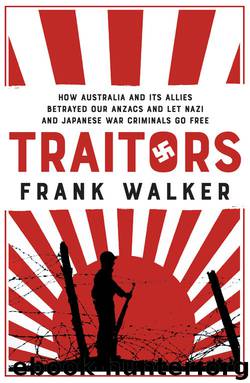
Traitors: Why Australia and its Allies betrayed our ANZACs and let Nazi and Japanese War Criminals by Frank Walker
Author:Frank Walker [Walker, Frank]
Language: eng
Format: azw3
ISBN: 9780733637162
Publisher: Hachette Australia
Published: 2017-07-25T04:00:00+00:00
8
IGNORE WAR CRIMES OF THE USEFUL
‘His file said he was “an excellent German scientist” and no indication he was pro-Nazi or pro-communist
– despite him once being a member of the SS.’
The 3000 determined and technically skilled men and women of T Force don’t get much of a mention in heroic action war movies. Nor does the name of their top-secret mission inspire awe and excitement. But Operation Paperclip was one of the most extraordinary projects of World War II, a mission that took its elite and highly educated agents deep behind enemy lines and at the forefront of the fighting. They were experts in all fields of science, engineering, aeronautics and weapons of mass destruction, from chemical and biological warfare to atomic bombs. Their high-level military IDs gave them top priority classification. They had the authority to commandeer planes, ships, trains, vehicles, huge amounts of money and even entire military units. Their helmets bore a distinctive red ‘T’, and they were supervised and assigned their targets by a 230-man Anglo-American mobile headquarters.1
The targets of T Force were 9000 of Nazi Germany’s top scientists, engineers and technicians. The operation had been planned since late 1944 as fears grew among the Allies that Nazi scientists were close to creating their own atomic bomb and biological weapons. Hitler’s Aryanisation program had forced many Jewish scientists out of scientific projects, however, and Germany’s race to the atom bomb slowed as a result. Half of Germany’s top scientists – including Albert Einstein – fled as Hitler took power in 1933. Many ended up working to create an atomic bomb for the Allies, including Enrico Fermi, Edward Teller, Klaus Fuchs, Victor Weisskopf and John von Neumann. But as the war was coming to an obvious conclusion, the Allies had a new concern. They feared that German scientists who had made astounding breakthroughs in jet engines, V2 rockets, biological weapons and superior tanks such as the Tiger might be captured by the Soviet Union and put to work for the communists in what many saw as a looming conflict with the wartime ally.
The question of whether these scientists were war criminals, responsible for the deaths of tens of thousands through the weapons they created, was not a consideration for T Force.
Operation Paperclip was given the official green light by the US Defense Department in July 1945, but operations had secretly begun a year earlier. As the Allied victory approached, the US Joint Intelligence Committee (JIC) – which reported directly to the military Joint Chiefs of Staff – set up the Joint Intelligence Objectives Agency (JIOA). It was set up specifically to recruit Nazi scientists at war’s end and put them to work on Allied weapons projects and scientific programs with the navy, army, air force and secret intelligence agencies. If the German scientists whom T Force recruited had been too close to Hitler to be allowed out in public in the US or UK, they were to work secretly at military facilities inside occupied Germany. The JIC was convinced that war with the Soviets was inevitable.
Download
This site does not store any files on its server. We only index and link to content provided by other sites. Please contact the content providers to delete copyright contents if any and email us, we'll remove relevant links or contents immediately.
Personalized inhaled bacteriophage therapy for treatment of multidrug-resistant Pseudomonas aeruginosa in cystic fibrosis by unknow(214788)
CONSORT 2025 statement: updated guideline for reporting randomized trials by unknow(102521)
Critical evaluation of the ProfiLER-02 study design and outcomes by Vivek Subbiah & Razelle Kurzrock(102046)
Cardiac gene therapy makes a comeback by Oliver J. Müller & Susanne Hille & Anca Kliesow Remes(101838)
Whisky: Malt Whiskies of Scotland (Collins Little Books) by dominic roskrow(74620)
Unveiling the design rules for tunable emission in graphene quantum dots: A high-throughput TDDFT and machine learning perspective by Şener Özönder & Mustafa Coşkun Özdemir & Caner Ünlü(51002)
A yeast-based oral therapeutic delivers immune checkpoint inhibitors to reduce intestinal tumor burden by unknow(40374)
Covalent hitchhikers guide proteins to the nucleus by Alexander F. Russell & Madeline F. Currie & Champak Chatterjee(40296)
Meet the Authors: Christopher R. Mansfield and Emily R. Derbyshire by Christopher R. Mansfield & Emily R. Derbyshire(40208)
Alkaline-earth metals promote propane dehydrogenation with carbon dioxide through geometric effects: Altering the reaction pathway by unknow(32814)
Induced iron vacancies boosting FeOOH loaded on sustainable Fenton-like collagen fiber membrane for efficient removal of emerging contaminants by unknow(32611)
Efficient electric-field-assisted photochemical conversion of methane to n-propanol exclusively over penetrated TiO2Ti hollow fibers by Guanghui Feng(32530)
Bi2SiO5 nanosheets as piezo-photocatalyst for efficient degradation of 2,4-Dichlorophenol by Hangyu Shi & Yifu Li & Lishan Zhang & Guoguan Liu & Qian Zhang & Xuan Ru & Shan Zhong(32469)
A novel NDIPTA organic heterojunction photocatalyst with built-in electric field for efficient hydrogen production by Jiahui Yang & Baojun Ma & Yongfa Zhu(32443)
Enhanced conversion of methane to liquid-phase oxygenates via hollow ferrite nanotube@horseradish peroxidase based photoenzymatic catalysis by Jun Duan & Shiying Fan & Xinyong Li & Shaomin Liu(32405)
Ordered macroporous superstructure of defective carbon adorned with tiny cobalt sulfide for selective electrocatalytic hydrogenation of cinnamaldehyde by Xiao-Shi Yuan & Sheng-Hua Zhou & San-Mei Wang & Wenbo Wei & Xiaofang Li & Xin-Tao Wu & Qi-Long Zhu(32335)
What's Done in Darkness by Kayla Perrin(27260)
Topological analysis of non-conjugated ethylene oxide cored dendrimers decorated with tetraphenylethylene: Insights from degree-based descriptors using the polynomial approach by A Theertha Nair & D Antony Xavier & Annmaria Baby & S Akhila(26631)
Investigation of mechanical and self-healing properties of hydroxyl-terminated polybutadiene functionalized with 2-ureido-4-pyrimidinone by Mohsen Kazazi & Mehran Hayaty & Ali Mousaviazar(26555)
